













.png?height=420&name=LinkedIn%20NewsletterArticle%20Headers%20(6).png)
Listen to the article
In today's edition:
- ROAD to Housing goes to final vote
- Inflation ticks up
- Existing-home sales increase
AI is here to replace our jobs... right? The recent employment numbers seem to tell a bit of a different story. Unemployment held steady at 4.3%, with upward revisions for March and April. Does this mean no jobs are being cut? Of course not, certain industries are being impacted more than others. But in aggregate this suggests a low-hire, low-fire environment where humans still play a role, and not the ‘major cuts’ moment for employment that some anticipated.
I recently heard the analogy to the “Jevons Paradox” (hand up I had no idea what that meant). This is the theory that as a resource becomes more efficient we tend to consume more of it. So as software engineering becomes more efficient, does that mean we need fewer engineers? Jevons says heck no. Now that we can all create our own software, you can imagine the consumption of it will skyrocket - and I have a hunch this new reality will create a few jobs that we don’t have today.
🎯 What’s Stirring
The 21st Century ROAD to Housing Act
The biggest federal housing package in decades is one step from the finish line. On Monday, the Senate passed the 21st Century ROAD to Housing Act, 85 to 5, and it now returns to the House, which hopes to vote within the next few days before sending it to the President. The bill funds construction programs, loosens some permitting and environmental review requirements, and modernizes federal housing programs.
The piece this audience has been tracking is the section titled "Homes Are For People, Not Corporations," which restricts large institutional investors, defined as those with control over more than 350 single-family homes, from buying single-family homes. Build-to-rent operators get a notable reprieve in the final text: it does not include a stricter Senate provision that would have required investors to sell newly constructed homes within seven years, a measure that had drawn concern from parts of the build-to-rent and real estate investment industries. For context on the cost side, NAR notes that regulatory costs alone add more than $131,000 to the price of a typical new home.
Consumer Price Index (CPI) for May 2026
Headline inflation hit 4.2% over the 12 months ending May, after 3.8% for the year ending April - the highest annual pace since April 2023 and the third straight month of acceleration. Monthly was +0.5%, a touch below April's +0.6%. The story is almost entirely energy: the energy index rose 3.9% in May and accounted for over sixty percent of the monthly all-items increase, with the Iran conflict driving the oil shock. Strip that out and it's much calmer - core CPI rose 0.2% in May and 2.9% over the past 12 months, with the monthly core actually coming in below forecast. Shelter cooled to +0.3% on the month. Worth noting for the Fed angle: futures traders aren't pricing in any rate cuts for 2026, and there's chatter about a possible hike.
The May Jobs Report
Hiring beat expectations by a wide margin. Employers added 172,000 jobs in May against a consensus near 80,000, and the prior two months were revised up by a combined 93,000. Wage growth eased to 3.4% year over year. The gains were concentrated: leisure and hospitality added 70,000, local government 55,000, and health care 35,000, while financial activities lost jobs. A few other readings: the share of unemployed who have been out of work for 27 weeks or longer rose to 27.5%, the highest of this cycle, and the average workweek was unchanged at 34.3 hours.
📊 The Metric
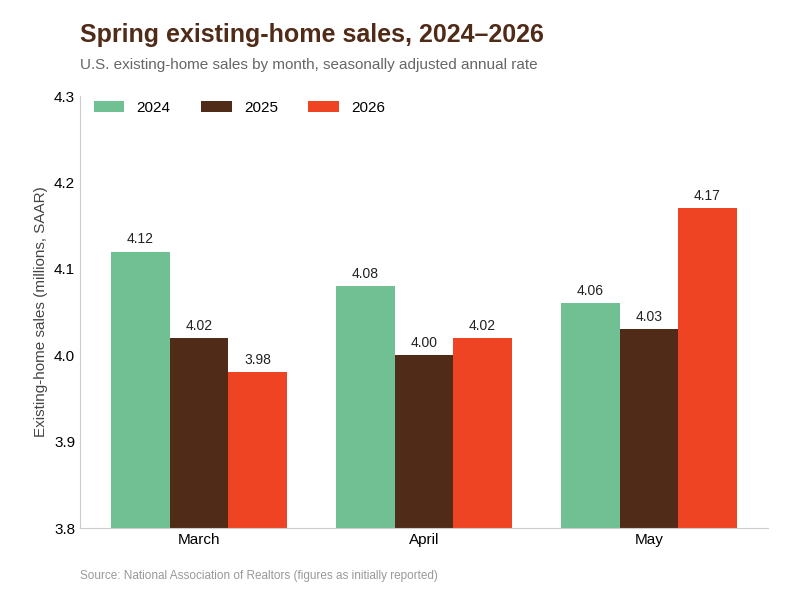
4.17 million
The Existing-home sales annual pace in May, up 3.2% from both April and a year earlier, the strongest reading since December. Across the last three springs, March and April 2026 tracked close to 2024 and 2025, while May pulled ahead of both.
One More Thing
and Chandan Economics' latest read of Census data, the number of households renting single-family homes rose 1.7% in 2025 to a seven-year high, reversing the 2016 to 2020 slide, when low mortgage rates let small landlords cash out and roughly a million rentals converted back to owner-occupied homes. What is driving the rebound this time is different: the growth is led by attached, purpose-built build-to-rent rather than scattered-site buying. Worth a look if you like the underlying charts.
The Beaker is a bi-weekly briefing from PlanOmatic on the economy, housing, and the forces shaping both. Have something we should cover? Reply to this email.
Follow us: LinkedIn | planomatic.com
.png)
.png)

.png)